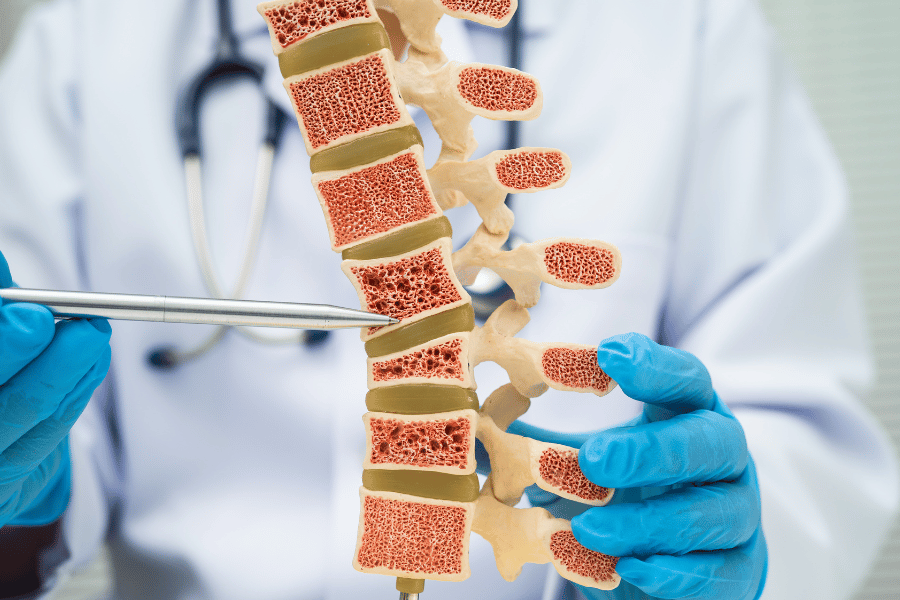
In my late twenties, I slipped and broke my shin. During recovery, a scan showed something I didn’t expect at that age: osteopenia — lower-than-normal bone density, the stage before osteoporosis. I’d spent most of my life lean, and barely exercising, and my bones had quietly paid the price. In response, I rebuilt my diet around bone-healthy nutrition to support my bone health and added strength training to my routine. A few years ago, a follow-up DEXA scan showed something different: my bone density had returned to normal. Osteopenia isn’t a life sentence, and bone health isn’t fixed at any age — it responds to what you do with it, in either direction.
Osteopenia vs. Osteoporosis: What the Difference Actually Means
Osteopenia and osteoporosis both describe lower-than-normal bone density, measured by a DEXA scan and expressed as a T-score. Osteopenia is the earlier, milder stage; osteoporosis is more advanced bone loss with a higher fracture risk. They’re not two separate problems — they’re two points on the same spectrum, which is exactly why the same strategy that helps prevent osteopenia from progressing is also used to manage osteoporosis once it’s already there.
Why Strength Training Rebuilds Bone Health
Bone isn’t static. It’s constantly being broken down by cells called osteoclasts and rebuilt by cells called osteoblasts. When you load your bones with resistance — through weights, bodyweight training, or any activity where muscles pull hard against bone — you trigger that rebuilding process to outpace the breakdown. This is different from cardio: walking and cycling are good for your heart, but they don’t apply enough mechanical stress to meaningfully build bone.
A study tracked postmenopausal women with osteopenia or osteoporosis over six months. The group that did structured strength training saw a statistically significant 1.82% increase in lumbar spine bone density, while the non-exercising control group showed no meaningful change. Six months, twice-weekly training, a measurable difference on a DEXA scan — that’s a realistic, achievable improvement.
What This Looks Like in Practice
Bone health doesn’t require lifting heavy every day. The research points to a few consistent principles:
- Load matters more than duration. A shorter session with real resistance does more for bone health than a long walk.
- Compound movements work best. Squats, deadlifts, rows, and presses load multiple bones and joints at once, rather than isolating one muscle.
- Nutrition supports the rebuild. Strength training triggers bone remodeling, but adequate calcium, vitamin D, and protein give your body what it needs to actually rebuild — diet and training work together, not separately.
- Progression is the point. Bone adapts to load the same way muscle does — it needs to be gradually challenged, not just repeated at the same weight indefinitely.
- Two to three sessions a week is enough to see change over months, based on the research above, not daily training.
- Consistency over years, not weeks. My own DEXA improvement showed up over roughly two years of regular training, not two months.
It’s Never Too Late to Start
My mom’s story adds a different piece to this. She was diagnosed with osteoporosis — a step further down that same spectrum — and started strength training in response. Two different diagnoses, the same underlying lever: consistent, progressive resistance training aimed at bone health, not just aesthetics or weight loss. It’s worth saying, too, that the benefit isn’t only in the bone density number on a DEXA scan — the muscle you build alongside it is what actually lets you carry groceries, get up off the floor, and move through the world with confidence as you age. Bone health and muscle go hand in hand, and together they’re what make mobility, independence, and freedom possible later in life, not just a longer healthspan on paper.
The Takeaway
If you’ve been told you have osteopenia, or you’re worried about bone health as you get older, strength training is one of the few interventions with real evidence behind it — not just for slowing bone loss, but for actually improving it. It won’t happen in a few weeks, and it isn’t about lifting the heaviest weight in the room. It’s about consistent, progressive load on your bones, sustained over months and years.
This post is for informational and educational purposes only and is not a substitute for professional medical advice. If you have concerns about your bone density, please consult your doctor, and ask about a DEXA scan if you haven’t had one.